
Swimming Motion Simulation & CV Tracking
A scalable camera-tracking and biomechanics simulation for competitive swimming analytics — bridging sports science with robotics control theory.
The challenge
Real-time swimming analysis is hard. Underwater cameras are expensive, fixed in place, and hard to calibrate. We needed a way to prototype tracking algorithms without an Olympic pool.
The solution
A full-scale Unity simulation that models swimmer biomechanics and a robotic camera rail. We used Control Barrier Functions (CBF) to guarantee the camera keeps the swimmer in frame.
Tech stack
Simulation environment
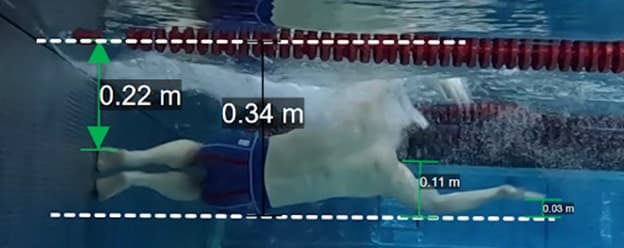
A 50m virtual pool with a configurable camera rail system. The swimmer object isn't just an animation — it follows parametric motion equations that mimic real stroke cycles, generating infinite training data for CV models.
Safety-critical tracking
The camera needs to move fast enough to track a sprinter but smooth enough to provide stable footage. We implemented Control Barrier Functions — a robotics technique that mathematically guarantees the camera never overshoots the rail or loses the target, even during rapid turns.
Impact & deliverables
Where this goes next
Scalable tech
Alternative to expensive camera systems.
AI analysis
Biomechanics for swimmers anywhere.
Startup base
Foundation for athlete performance tech.
Research demo
Valid prototype for portfolio demos.